The draft Local Nature Recovery Strategy for Shropshire and Telford & Wrekin (the historic county of Shropshire) can be found here. This is a low-resolution version, with all the photos removed.
The full colour version, including photos, can be found on the Council website, lnrs-full-document-high-res.pdf It takes a short while to download.
Public consultation on this draft closed on 16 October 2025, and Natural England have also commented. The draft is now being revised, and is due to be considered by the Cabinets of the two local authorities in early 2026.
The submission on priority bird species to be incorporated into the draft LNRS made by Shropshire Ornithological Society (SOS) can be found here. It identifies 67 declining species that are included on the LNRS “long list”, and 11 species that have been specifically identified for action on the LNRS short list, as listed under “Priority Species” below. It also groups the priority species into habitats (“assemblages”), and recommended that they be specifically identified as beneficiaries of targeted improvement to those habitats, but the authors of the draft sent out for comment responded that “only species requiring additional actions over above the habitat actions were included”.
Priority Species
The draft LNRS lists 25 priority species needing specific actions to reverse their decline and remove the threat of local extinction, including eight priority bird species which are on the Shropshire Ornithological Society (SOS) Red or Amber Lists of Breeding Birds of Conservation Concern in Shropshire
- Curlew
- Dipper
- Nightjar
- Pied Flycatcher
- Red Grouse
- Swift
- Wheatear
- Willow Tit
It also lists several groups of species that are also on the SOS lists, and which are dependent on specific habitats
i) Three species reliant on Heathland and grassland mosaics, including ffridd:-
-
-
- Snipe
- Tree Pipit
- Whinchat
-
ii) One species reliant on Built environment and amenity space:-
-
-
- Swift
-
iii) Three species reliant on Water and wetlands:-
-
-
- Dipper
- Common Sandpiper
- Kingfisher
-
iv) Two species reliant on Farmland, including hedgerows:-
-
-
- Tree Sparrow
- Yellowhammer
-
v) One species reliant on Open habitats:-
-
-
- Meadow Pipit
-
Several of the species listed above are also listed in relation to other habitats:
- Curlew, Lapwing and Snipe are listed as Ground-nesting Birds and Grassland Birds
- Snipe is also listed as a Species reliant on Bog and other wetland habitat
- Whinchat, Red Grouse and Nightjar are listed as Species reliant on Open habitats
Linnet and Skylark (Farmland and Grassland), and House Sparrow (Built Environment), are also highlighted in the LNRS. These species are not included on the SOS lists, because their decline had mostly occurred before the base line date (1990), but they are on the national Birds of Conservation Concern (BOCC5).
Distribution of Priority Species
- To help target actions to help these species, the Relative Abundance maps from the Bird Atlas project in 2008-13 can be found here.
These maps show where the species was recorded, and are based only on counts made during timed tetrad visits (TTVs) in the breeding season. Each symbol on a map occupies a 2×2 kilometre survey square, known as a tetrad. There are 870 tetrads in the County. Such maps have only been produced for species recorded on more than five TTVs. The Breeding Distribution map is reproduced instead for species listed above which were not recorded on five TTVs. Two two-hour visits were made to the vast majority of tetrads, the first in April or May, and the second in June or July.
The colour scheme highlights the areas of highest density. The darkest colour represents around 25% of squares where the highest numbers were counted on TTVs. Then, going from deepest to palest colours, the next band also includes about 25%, then the lowest 50%. The number of squares in each of the three bands varies, because the total reflects the number of squares where the species was found during TTVs. The palest colour shows squares where the species was found during the Atlas period, but not during a TTV.
It must be stressed that the Relative Abundance maps only give a general impression of densities. Only a small proportion of a tetrad can be visited in two hours. Observers were asked to visit all the habitats in the square, but in many cases this was not possible, and in others it meant that roughly the same amount of time was spent in each habitat, when one habitat may be predominant in the square. Luck plays a part as well, as widespread but scarce species like Sparrowhawk, nocturnal species such as the owls, or skulking species like some warblers, may be overlooked, and detectability of most species varies according to the prevailing weather conditions and time of day.
The time within the two-month period when the count was made also had an effect. In particular, many counts in the early period were carried out before the bulk of the summer visitors arrived, and, in the late period, many species, but not all, would still be in song in early June, but not in late July. Even so, these maps are the first indication we have of the relative abundance of different species in different habitats.
Non-breeding Birds
Apart from breeding birds, LNRS includes the need to protect the important winter Lesser Black-backed Gull roost at Ellesmere (not mapped, but in Ordnance Survey 10-km square SJ43).
Farmland Bird Assemblage
Defra publishes a Farmland Bird Index each year, based on population trends found by the national annual British Trust for Ornithology (BTO) breeding bird survey. There are 12 specialist farmland birds included in the index: Corn Bunting, Goldfinch, Grey Partridge, Lapwing, Linnet, Skylark, Starling, Stock Dove, Tree Sparrow, Turtle Dove, Whitethroat and Yellowhammer.
Overall farmland bird populations have declined significantly (around 62% in the UK since 1970), and specialist species are particularly hard-hit, with some declining by over 80%.
For more detail, see https://www.gov.uk/government/statistics/wild-bird-populations-in-the-uk/wild-bird-populations-in-the-uk-and-england-1970-to-2024.
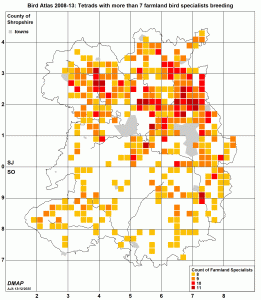
The map above shows the number of each of these 12 farmland specialists recorded in each tetrad during the Bird Atlas 2008-13. The darker (redder) squares hold more species.
Actions to improve habitats for these farmland birds should be targeted at the tetrads near to the darker squares.
Curlew Maps (the highest bird species priority)
SOS has organised a nest protection and chick tracking project since 2021. The 51 nests found are included on the draft LNRS interactive map (8 in the Upper Clun, 8 in Clee Hill, 22 in the Strettons area, and 13 around Oswestry). Note that the same sites were searched each year, and the nests of some pairs were found in more than one year.
The vast majority of the County Curlew population is monitored by 10 Community Wildlife Groups. The areas covered by these Groups, overlain on the Curlew distribution map from the 2008-13 Shropshire Bird Atlas, can be found here. The table underneath the map lists the 10 areas, the year when Curlews were first surveyed, and the percentage decline found since monitoring started. Territories are large, and are mapped at the tetrad (2×2 kilometre square) level. The maps showing the Curlew distribution in each of the 10 areas can be found here. These maps will be updated annually.
Updating
This section of the website will be updated when the revised LNRS has been approved by the two Local Authorities, and Natural England, hopefully in early 2026.
Leo Smith
29 December 2025