If you see evidence of breeding Red Kites, we would like to know please. Contact Leo Smith: leo@leosmith.org.uk or 01694 720296.
Red Kites almost became extinct in Wales in the 1930s, but the population slowly increased, reaching 100 pairs in 1993. They have spread since then, and two pairs nested unsuccessfully in Shropshire in 2005. One pair fledged two young here in 2006, the first successful breeding in Shropshire for nearly 130 years. Six nests were found in 2007, and, by 2010, the population had reached 20 breeding pairs. Numbers have continued to increase.
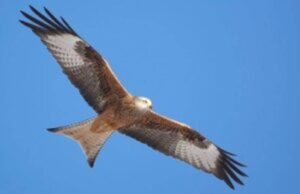 In 2022, 59 nests were found, the highest number in any one year yet, and over 50 nests were also found in 2023 and 2025. In total, by 2025, 561 nests have been found, 72% have been successful, and over 700 young are known to have fledged from Shropshire nests.
2025 was the 20th Anniversary of the first nest found in the County for almost 130 years, and a detailed report has been produced to celebrate this Anniversary, “Red Kites in Shropshire 2005-25”. It is the first item in the following catalogue of Annual Reports. The anniversary document summarises, and puts into context, the series of reports produced since 2013, which can be found following.
- Red Kites in Shropshire – 2005-25 [.pdf]
- Red Kites in Shropshire – 2021/22 [.pdf]
- Red Kites in Shropshire – 2020 [.pdf]
- Red Kites in Shropshire – 2019 [.pdf]
- Red Kites in Shropshire – 2018 [.pdf]
- Red Kites in Shropshire – 2017
- Red Kites in Shropshire – 2016
- Red Kites in Shropshire – 2015
- Red Kites in Shropshire – 2014
- Red Kites in Shropshire – 2013
Almost all nests found have been in the Shropshire Hills National Landscape (previously known as the Area of Outstanding Natural Beauty, the AONB) in the south-west Shropshire hills, but the range is spreading, and there have been an increasing number of nests found in the north, and in the south-east, quadrants.
Kites usually don’t breed until they are two or three years old. Young birds wander widely, so many sightings will be of immature birds. However, there should be even more nests to find this year, including more in north and east Shropshire. Most nests are started in late March, but first-time breeders may not lay until late April or early May. Nests are usually built in large trees, on steep hillsides. Young fly in late June or early July. Nest sites are kept confidential.
We are still trying to find all nests, so reports are wanted, please, of
- a pair together in spring,
- displaying birds,
- one seen several times in the same place,
- one going into a wood, any time between March and June.
Nests are difficult to find, and easy to overlook, so if you know of a site, please don’t assume that we know about it.
All reports will be treated in absolute confidence. Kites are very shy, and they are legally protected. It is an offence to disturb them, but this monitoring is carried out under licence.
Over 200 young Kites were wing-tagged in the nest between 2006 and 2021. Reports of these wing-tagged birds are wanted too, please. Photographers are requested to look carefully at any Kite photos they have. It is often possible to read the tag, if the image is sharp and can be enlarged.
Most large gatherings, at winter roost sites or for feeding over farm fields while they are being ploughed or cut, are also found mainly in the south-west, but are increasingly being found in the north, or the south-east. Such large gatherings are important evidence of expansion of range, so any groups of more than 20 Kites should be reported too, please.
All reports should be sent to leo@leosmith.org.uk or 07791 901732.
The Welsh Kite Trust promotes conservation, organises nest protection, and monitors the increasing population and range. You can support this work, and receive on-line newsletters, by joining the Friends of the Welsh Kite. Further information from the Trust Office at “Samaria”, Nantmel, Llandrindod Wells, Powys LD1 6EN, or from Leo Smith.
Return to Shropshire Raptor Study Group
Return to Bird Conservation
